
In the fall of 1986, I was an undergraduate student at the University of Wisconsin–Whitewater, taking a creative writing class. I was not a typical undergraduate. I was returning to school at the age of 31, after a ten-year interruption due to my economic circumstances. I came back to school with a heavy feeling of having lost many years by not being able to complete my education in the traditional timeframe of my twenties and continue on to the next stage of life. And now there was the realization that I would spend another six years or so by the time I earned the MBA I desired, which I hoped would enable me to have a happier and more prosperous life.
With this sense of lost time, I began writing my creative writing assignment. It began with a thought—we spend perhaps a fourth or even a third of our lives in school, acquiring the knowledge and degrees to pursue a career and make a living. We may be well into our twenties before we begin putting that education to productive use.
What if knowledge could be manufactured in laboratories and implanted in our brains?
It could save so many of our most productive years. That thought led me to more questions. What actually happens when we learn something? Somehow that knowledge gets stored in our brains. How does that happen? What if knowledge could simply be transferred into our minds through secondary means such as isotopes or injections? Also, what happens if the degree we worked years to obtain—and the skills we acquired—becomes obsolete? There is not enough time in life to keep changing tracks every time the world changes.
What if knowledge could simply be transferred, replaced, or enhanced to align with the needs of a changing world? Then we could change professions as the world changed and different skills became more valuable. It was a flight of fancy. My professor was amused, and so were my classmates when I presented the concept.
I could not have imagined that forty years later, something remarkably similar to my old idea would become part of our everyday lives. Knowledge isn’t being transferred into our brains as I had imagined. Instead, technology is giving us the ability to enhance our own knowledge, skills, and capabilities almost instantly.
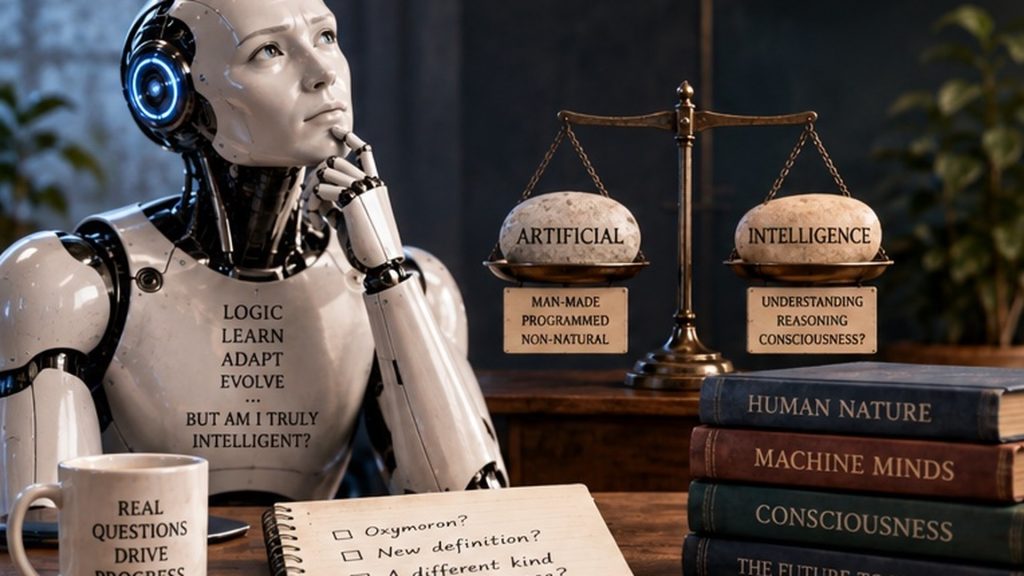
We call it Artificial Intelligence. And this is where my confusion begins.
Is It Really Artificial?
In Artificial Intelligence, “artificial” essentially means human-made. We are distinguishing intelligence created through human technology from the biological intelligence of the human mind. But that is not necessarily what the word artificial communicates in everyday language. Artificial often suggests something fake, imitation, synthetic, or somehow less genuine than the real thing—artificial flowers, artificial flavoring, artificial jewelry.
What we are really describing is human-made intelligence. Perhaps that phrase is too cumbersome for everyday use. A simpler term was needed, and somehow we settled on Artificial Intelligence. The term is now firmly embedded in our language, and there is little reason to try to change it. But if a term requires an explanation before its intended meaning becomes clear, perhaps it is worth thinking about what this technology actually represents.
For me, another term comes much closer: Enhanced Intelligence.
Enhanced Intelligence
I don’t think of AI as an alternative to my own intelligence, and I don’t want it to replace my thinking. I want it to enhance my thinking. In fact, my experience developing this very article is an example.
The original thought is mine. The experience of returning to college at 31 is mine. The creative writing assignment in 1986 is mine. The concern about how much of our lives we spend acquiring knowledge and making a living is mine. The questions about the word artificial are mine. But I can bring those thoughts to AI and have a conversation. I can question my assumptions, explore another way of expressing something, discover a weakness in my argument, reject a suggestion that doesn’t represent what I believe, and pursue another thought that emerges from the discussion. The process does not have to replace my intelligence. It can enhance it.
If I fertilize the grass in my backyard, I am not replacing the grass with AstroTurf. I am giving the natural grass something that helps it grow greener and stronger. That is increasingly how I think about AI.
The human mind remains the human mind. Our experiences, imagination, emotions, judgment, values, and choices remain ours. AI becomes another resource we can use to extend what that mind is capable of doing. Perhaps, then, the most useful way to think about Artificial Intelligence is not as artificial thinking replacing human thinking, but as human intelligence enhanced by a human-made tool.
Why Does Enhancement Matter?
I need to begin with a philosophical perspective. What is life? Life is essentially time.
Our lifespan is finite, even if it reaches a hundred years. There is only so much time available to us. This is something I was already struggling with at 31, although I may not have understood it quite this way at the time. I felt I had lost years. I was spending more years acquiring an education. And I knew that the knowledge and skills I was acquiring could themselves eventually become outdated. That was the real reason behind my fantasy about manufactured knowledge. I wanted to do more with the time available to me.
Forty years later, that question remains relevant to all of us. We are constantly pressed for time. There never seem to be enough hours in the day to do everything that needs to be done. We spend enormous amounts of our lives learning, working, organizing, researching, communicating, and simply taking care of the countless tasks required to function in modern life.
AI can help with some of that. It can help us analyze information, write and organize material, explore ideas, learn unfamiliar subjects, turn imagination into images, plan activities, and accomplish many routine intellectual tasks more quickly. The individual tasks will continue to change as the technology develops, but the larger benefit is more fundamental: AI can enhance what we are capable of accomplishing with our limited time.
Life Is Time
This, to me, is where the real potential of AI lies. We often talk about AI in terms of productivity—how much more work a person or company can accomplish. But productivity does not have to mean simply doing more work. If something that once required three hours can be accomplished in one, we have gained two hours.
What happens to those two hours? We can use them to work more, produce more, compete more, and accumulate more. There is nothing preventing us from filling every minute AI saves with another task. But we have another choice. We can use some of that time to be with people we care about, take care of ourselves, learn something simply because it interests us, create something, walk outside, think, or enjoy whatever gives meaning and pleasure to our lives.
AI cannot decide what is important to us, nor should it. The technology can enhance our abilities. It can help us use our knowledge more effectively. It can help us accomplish certain things faster. It may even help us recover some of the time that modern life continually consumes. But what we do with that time remains our decision.
The resource is there. The responsibility is ours.
Perhaps Artificial Intelligence is not really an oxymoron. Artificial, after all, can mean human-made. But I have come to think that Enhanced Intelligence better describes the relationship I want to have with it—not artificial instead of human, and not machine instead of mind, but human intelligence enhanced by a tool humans created.
And if that enhancement gives us back even a little more of our limited time, the most important question may no longer be what AI can do.
Instead, we should think,
What will we do with the additional time it frees up for us?
——————————————————————————————
COMING NEXT:
The Illusion of the Cloud — Why Data Centers are Just Factories.
In my next essay, I will dismantle the weightless marketing myths of the tech industry and explore the very real physical, economic, and environmental impact these “knowledge factories” are having on our local communities.
Stay tuned.